Looking for Callie
Part Two of Four: The Search Begins

Once I began wondering what became of Callie Campbell, the thought lived with me like an odd mystery. One that nudged me at random times and places, as if it needed to get my attention.
That may sound strange. After all, she had been gone from this earth for years by then, and I knew almost nothing about her. Just a name. A place. A photograph made in October of 1916. A child in a cotton field outside Shawnee, Oklahoma, looking into Lewis Hine’s camera with an expression that had crossed nearly a century to find me.
Still, I kept thinking about her.
Readers at book signings had asked the question often enough. “What happened to that little girl?” They would study the cover of my cotton book, run a finger lightly across her face, and ask as if I ought to know. Truth be told, I felt like I ought to know too.
So I did what people do now when they have a question that won’t leave them alone. I sat down at my computer and searched for a newspaper in Shawnee, Oklahoma.
I found one.
I wrote a polite email to the publisher explaining who I was, why I was writing, and how I had become interested in the life of a girl photographed there in 1916. I hit send and waited.
Nothing.
A couple of weeks later I wrote the editor.
Nothing again.
I repeated this process, visually walking down the list of contacts at the newspaper, checking off names every week or two. Publisher. Editor. Assistant Editor. Sports Writer. Advertising Director. Every few weeks I would send another note into the Oklahoma air and go back to my own life in Tennessee.
Then one day the phone rang.
A woman introduced herself as Ann Weaver. She said she was a feature writer at the Shawnee paper and had come across my email. She told me she found the story fascinating and wanted to write about it.
Now we were getting somewhere.
She interviewed me and soon an article appeared about my search for Callie Campbell, the child cotton picker lost to history. I was hopeful. Newspapers, especially in smaller towns, still carry a kind of civic memory. Somebody always knows somebody. Somebody remembers where people lived, who they married, what little community or road their people came from.
When the article ran, my answering machine lit up.
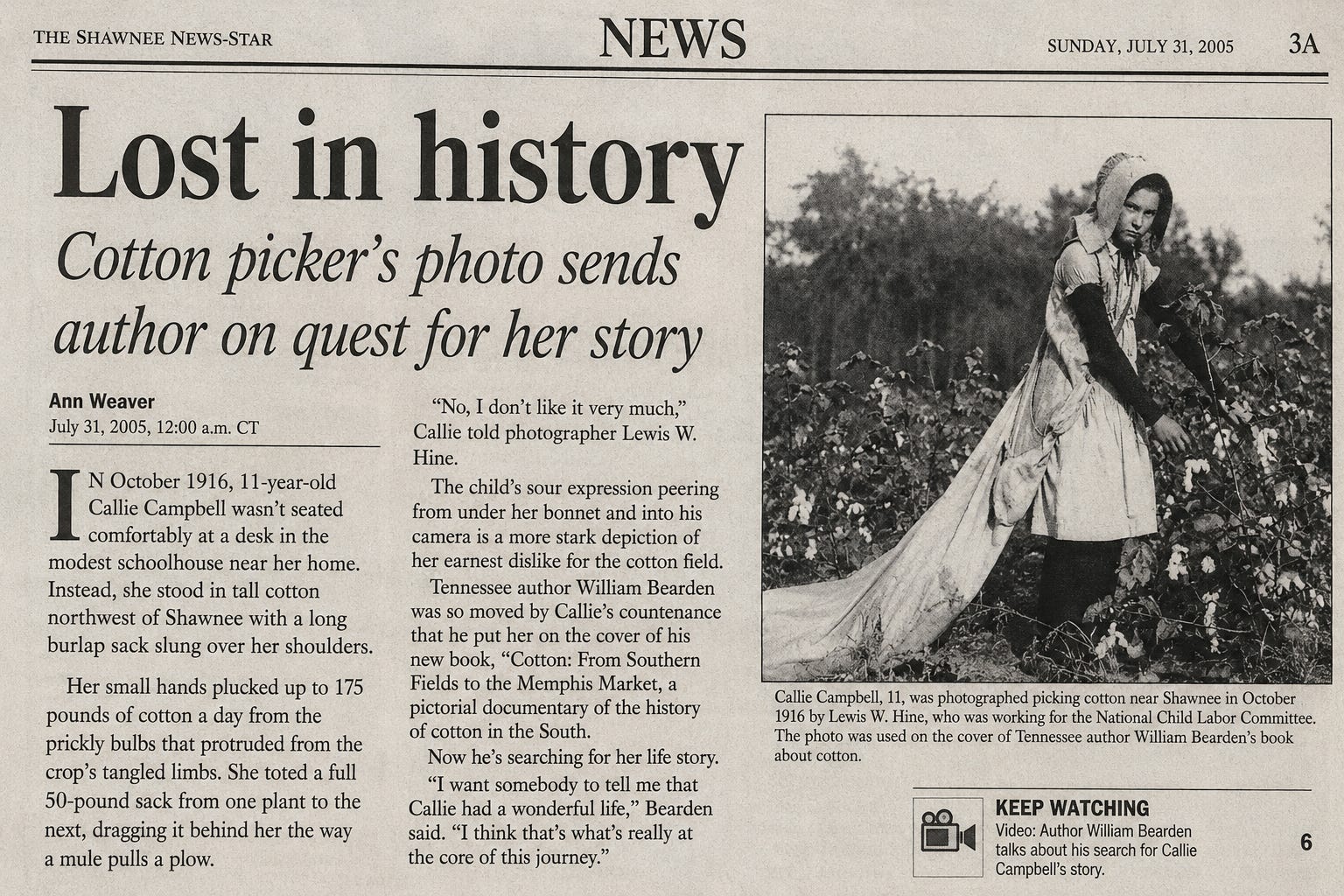
Calls came from people saying things like, “That could have been my mother,” or “I remember children working fields like that,” or “I knew people just like that years ago.” Many were kind. Some were moved by the photograph itself. But no one could tell me exactly what had become of Callie.
Still, the search had stirred something.
A few days later, I received a call from a woman at a local funeral home in Shawnee. She told me that Callie Campbell was buried there. She had records. A husband named Marvin. Dates. A few scattered details. Enough to prove that the child in the photograph had gone on to live a full human life beyond that cotton field.
That mattered more than I can explain.
There was another clue. Family members had later connections to Massachusetts. What? Okay, I’m game.
Now I had a thread to pull.
The family name was uncommon enough that I began doing what now sounds both foolish and determined. Every week or two, when I had a spare hour, I would look up people with that surname in Massachusetts and start making phone calls.
Most conversations ended quickly.
“Not interested.”
“You’ve got the wrong number.”
“No, I don’t know any Callie Campbell.”
Sometimes I barely got past introducing myself before they assumed I was selling insurance, vinyl siding, or religion.
I’d apologize, thank them, and cross another name off my list.
But I kept calling.
Something in me believed that a person should not simply vanish because time had passed.
Then one afternoon a man answered the phone. I gave my usual explanation. My name is Willy Bearden. I wrote a book about cotton. I’m trying to find information about a girl whose photograph was taken in Oklahoma in 1916.
There was the familiar pause of skepticism.
Then I asked the question I had asked so many strangers before.
“Does the name Callie Campbell mean anything to you?”
There was a long silence.
Then he said, very quietly:
“You’re going to want to speak to my wife.”
Willy, this sounds exactly like something I would do. I’m sure glad there are others that feel like people should not be forgotten.
Good stuff, Willie